
Posted on

The Death of the “Department of No”

Thoughts of the Fractional ChiefWhy the “Department of No” Is Dying
(And How to Build an Army of Trusted Sensors)

There is a quiet war raging inside modern enterprises, and it isn’t between your IT department and overseas hackers. It is between your Information Security (InfoSec) team and your own employees.

Consider a scenario playing out in corporate offices globally:
An organization deploys an aggressive new authentication policy on its corporate environment. To “maximize” security, the system demands re-authentication multiple times a day.
It doesn’t care if a user is actively typing – it abruptly forces a re-login
in the middle of a sentence, wiping out unsaved form data.

You say – this surely doesn’t happen?
Yet, I’ve seen it. In real life. 

Eventually, a high-performing employee simply stops using the system.

When a client asks, “Why aren’t you logging into the platform?” the worker provides an honest, devastating response:

“The security tools are so disruptive to production that it is impossible to do any work in them. If your system fails to recognize an active, ongoing session, that isn’t security—it’s a productivity tax and a fundamental design flaw.
Fix it.”

When a company’s strongest security controls actively throttle revenue generation, the security posture has failed.
Security should be a locked door, not a treadmill employees must sprint on while trying to type.

As a seasoned tech chief who has sat in both the business-growth and risk-management seats, I view this tension through a very pragmatic lens. True protection does not come from draconian restriction – It comes from:
Smart Security.

An approach built on economic deterrence, user enablement, and turning your workforce from perceived vulnerabilities into your most agile defense asset.

1. The Core Philosophy: Attacker Economics

Many security professionals treat corporate defense as a binary: You are either 100% secure or you are completely exposed, only that – this mindset is an executive failure. True security is an economic (and to some degree, a political) optimization problem.

The foundation of Smart Security rests on a simple formula: maximize the cost to the attacker until it exceeds the potential value of the targeted asset.

Smart security aims to make your organisation less profitable, less predictable, and less scalable to attack than the alternatives.

In simple plaintext; 
 

If a cybercriminal targets corporate data worth €10,000 on the dark web, your job is not to build a billion-euro fortress.
Your job is to architect a defensive barrier that costs the attacker €10,001 in resources, computing power, or time to breach.
The moment the math doesn’t track, the rational, financially motivated adversary moves on to an easier target – nobody in their sane minds spends €100 to get a return of €99.

The Nation-State Exception

There is, of course, a critical caveat to this economic rule – If your organization is targeted by a politically or ideologically motivated adversary, such as a state-sponsored Advanced Persistent Threat (APT) group, the ROI model breaks down as these actors possess virtually unlimited budgets and no requirement for financial return. 

If a nation-state actor is fully committed to breaching your network, they will likely find a way in,
practically no matter what.

In these rare, high-stakes environments, trying to prevent initial entry by torturing employees with constant MFA prompts is like using a cardboard shield against a railgun – Instead, the strategy must pivot from absolute prevention to resilience and blast-radius containment.
You design the architecture under the assumption of breach, ensuring the adversary cannot move laterally or cause catastrophic, existential damage. Make your staff your allies and educate on the how, why and when’s, and make it rewarding!

2. Security Friction Breeds “Shadow IT”

When an InfoSec team implements oppressive security controls, they do not actually increase the cost to the attacker – they merely increase the cost to the employee.
This is the classic mistake of confusing friction with security.

When you force an employee to navigate hostile user design, they do not stop needing to meet deadlines – Instead, they find workarounds. They copy-paste sensitive corporate data into unmanaged local text files to avoid losing work, they migrate projects to personal Dropbox folders or unsanctioned generative AI tools.

This is the birth of Shadow IT.

Traditional CISOs routinely blame the workforce for being reckless when these workarounds occur, but a strategic leader looks at Shadow IT and recognizes it as a structural security failure, not a personnel failure.
High friction forces good employees to make bad security decisions just to cope and do their jobs.

Smart Security focuses on reducing friction so that compliance automatically becomes the path of least resistance.

3. From the “Department of No” to Business Enablers

To eliminate Shadow IT and align the organization, InfoSec must undergo a cultural evolution. The legacy approach to security was bureaucratic and binary: Is this new software or workflow 100% risk-free? No? Then block it at the firewall.

A modern, strategic InfoSec function operates as a business enabler. Its default posture must shift from a flat “No” to a collaborative “Yes, and here is how we do it safely.”

Legacy “Department of No” The Smart Security Enabler
“You cannot use this external generative AI tool. It is completely blocked.” We see how this AI tool triples your output. Let’s route it through our private API wrapper so company data doesn’t leak into public training models.”

This shift does not mean InfoSec abdicates its governing duty or becomes a rubber stamp.
As executive leaders, the buck stops with us and InfoSec retains the absolute right, and the explicit duty to veto an initiative if the residual risk inherently exceeds the possible gains or violates the organization’s risk appetite.

They are the ultimate gatekeepers, and rightly so.

However, because a Smart Security team rarely issues a flat rejection, their veto carries immense corporate weight.
When they finally do say “No,” the business units do not push back or seek a workaround – they comply immediately because a solid foundation of trust and understanding of why, has been built.
The C-suite and the board will always back a CISO or InfoSec team that says, “We engineered three different architectural workarounds to make this project happen, but the inherent risk remains unacceptable.”

4. Turning the Workforce into “Trusted Sensors”

The ultimate goal of Smart Security is to build a high-functioning ecosystem that leverages distributed intelligence. By pairing the technical expertise of the security team with the operational context of the workforce, you create a powerful symbiosis.
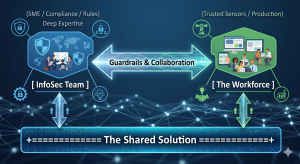
InfoSec understands the threat landscape, regulations (ISO, NIST, SOC2, …), and system vulnerabilities. The users understand how the business actually functions, what clients require, and where the operational bottlenecks sit. When these two forces work in conjunction, they discover viable solutions that satisfy compliance while maintaining production velocity.

Crucially, this model transforms employees into trusted sensors and early detectors.
No automated Endpoint Detection and Response (EDR) software or AI-driven email filter is flawless.
The ultimate line of defense against sophisticated social engineering or a targeted Business Email Compromise (BEC) is a human who notices that something is “off.”

If an employee feels valued and supported by InfoSec, they will instantly flag a suspicious event, but if they operate in a culture of fear, resentment, or high friction, they will stay silent, or blindly click through authentication prompts just to clear their screens.

5. Gamifying the Culture: The InfoSec Challenger

How do you bring this philosophy to life?

You take security awareness out of the realm of boring, punitive, check-the-box compliance compliance training and turn it into a transparent, gamified corporate sport.

Instead of deploying trick phishing simulations designed to catch employees out and sentence them to mandatory training videos, flip the paradigm entirely – Challenge the workforce to catch the InfoSec team out.

By launching a monthly “IT InfoSec Challenger of the Month” initiative, you incentivize proactive vigilance through friendly competition:

  • The Scope: Staff members earn points and recognition for providing valuable security insights, flagging emerging industry threat vectors, identifying an operational vulnerability, or spotting a live configuration error in an internal corporate application, acting as a collaborative and willing extension to the InfoSec team.

  • The Rewards: The prizes do not need to be massive corporate cash payouts. In organizational psychology, status and micro-rewards drive higher engagement. A bottle of bubbly, a digital badge on the companywide corporate newsletter, a small desk trophy, or a dinner voucher for two with their plus-one creates highly coveted bragging rights and a personal reward with recognition that stays with them.

This framework creates a no-lose scenario for the enterprise. If staff members successfully catch a blind spot or process vulnerability, InfoSec wins because they can patch the flaw before a malicious actor exploits it.
If the staff fails to find a vulnerability but stays actively engaged trying to do so, InfoSec still wins because the baseline vigilance of the entire company skyrockets.

When a member of the accounting or operations team wins the award, security ceases to be an abstract corporate policy – It becomes a badge of honor celebrated among peers.

The Bottom Line

A business exists to generate value, serve its clients, and ship production.

The Infosec function exists to ensure the business survives to keep doing so, and if security throttles production to zero or just becomes the “No”,it fails its primary objective.

The core of leadership boils down to a simple mandate:
Allow people to do their jobs with minimum friction, and make it as safe as we possibly can.

By treating your workforce as trusted partners, designing workflows around human behavior, and gamifying vigilance, you dismantle the legacy friction that compromises modern enterprises, and you stop being seen as the enemy and disabler and instead, you become a core pillar of operational excellence and a practical partner.

That is part of how you build a resilient, secure, and highly profitable enterprise.

 

Posted on

EU AI Act

Introductory guidance to the EU AThoughts of the Fractional ChiefI Act,
formally Regulation (EU) 2024/1689.

  • A regulation applies directly across the EU, unlike
    a directive which normally needs national transposition.
  • It entered into force on 1 August 2024,
    with obligations phased in over time.
  • Not all parts has been put into full enforcement as of yet,
    but will be phased in.
    See the timeline further down. 

Disclaimer: 
Please note that this does not constitute legal advice, but only serves as a general guidance to the current state of the EU AI Act As a quick introduction as to do’s and don’ts for most situations. Specific legal advice must be sought individuall where applicable and especially so where it is flagged as a “risky practice”. 

Timeline:

Date What comes into force
Already in force: 2 February 2025 Bans on prohibited AI practices, plus AI literacy duties
Already in force: 2 August 2025 General-purpose AI model obligations, AI Office/governance provisions, penalties framework
Main 2026 step: 2 August 2026 Most of the AI Act starts applying, including many high-risk AI obligations, transparency rules, notified-body rules, market-surveillance rules, and deployer/provider obligations

High-risk AI systems, particularly Annex III areas such as employment, education, access to essential services, law enforcement, migration, justice and democratic processes.
Transparency duties, such as disclosure around AI interaction and AI-generated or manipulated content.
Provider and deployer duties, including documentation, risk controls, logs, human oversight, monitoring and correct use.
Market surveillance and enforcement machinery becoming much more relevant in practice.
Penalty exposure becoming more concrete across a wider set of breaches.

Later: 2 August 2027 Full roll-out under the original timetable, including some high-risk AI systems linked to regulated products

For 2026 planning, treat 2 August 2026 as the main compliance deadline unless your lawyer confirms that your specific AI category is covered by a formally adopted extension.

For an R&D/software business, prioritise before August:

  • Inventory all AI systems.
  • Classify each one: prohibited, high-risk, transparency-only, GPAI-based, or low-risk.
  • Identify whether you are a provider, deployer, importer, distributor, or product manufacturer.
  • For anything touching hiring, scoring, biometrics, education, safety, credit, insurance, public services or legal decision support, assume it may be high-risk until checked.
  • Put documentation, logging, human oversight, data governance and user disclosure in place.

The final “everything is fully live” date is not this year. It is currently 2 August 2027, subject to the newer extension proposals as may happen. 

Core idea

The Act regulates AI by risk category:

Category Meaning Status
Prohibited AI Uses considered unacceptable Banned
High-risk AI AI used in sensitive areas such as safety, employment, education,
law enforcement, critical infrastructure, migration, credit, essential services
Allowed, but heavily regulated
Transparency-risk AI Chatbots, deepfakes, emotion recognition,
biometric categorisation in some cases
Allowed with disclosure duties
General-purpose AI models Foundation models, including LLMs Allowed with provider obligations
Low/minimal risk AI Most ordinary AI tools Mostly unregulated by the Act

What is not allowed

The main banned uses include:

Prohibited practice Plain-English meaning
Manipulative or deceptive AI causing harm AI that materially distorts people’s behaviour in harmful ways
Exploiting vulnerabilities Targeting children, disabled people, elderly people, or economically/socially vulnerable groups in harmful ways
Social scoring Public or private scoring of people leading to unjustified or disproportionate treatment
Predictive policing based mainly on profiling Predicting criminal risk from personality traits or profiling alone
Untargeted scraping of facial images Building facial recognition databases by scraping CCTV or the internet
Emotion recognition in workplace or education Generally banned, except narrow safety or medical cases
Biometric categorisation of sensitive traits Inferring things like race, political opinions, religion, trade union membership, sex life or sexual orientation
Real-time remote biometric identification in public by law enforcement Generally banned, with narrow exceptions requiring safeguards

These prohibited-practice rules have applied since 2 February 2025.

What is allowed but regulated

High-risk AI is allowed, but you need a compliance system around it. Common high-risk areas include:

Area Examples
Employment CV screening, hiring, promotion, termination recommendations
Education Exam scoring, admission ranking, learner assessment
Essential services Credit scoring, insurance eligibility, public benefits
Critical infrastructure Safety-related AI for energy, transport, water, telecoms
Law enforcement Risk assessment, evidence analysis, crime analytics
Migration and border control Visa, asylum, border-risk assessment
Justice and democracy Tools assisting courts, legal interpretation, election influence

The Act also treats some AI as high-risk if it is a safety component of a regulated product, for example machinery, medical devices, vehicles, aviation or other CE-marked safety products.

Must do: high-risk AI

If you provide or place a high-risk AI system on the EU market, the main duties are:

Duty Meaning
Risk management Identify, assess and reduce foreseeable risks
Data governance Training, validation and testing data must be suitable, representative and checked for bias where relevant
Technical documentation Keep evidence showing how the system works and complies
Logging System must produce logs sufficient for traceability
Transparency to deployers Users must receive clear instructions, limits, accuracy info and intended use
Human oversight Humans must be able to monitor and intervene appropriately
Accuracy, robustness and cybersecurity System must meet declared performance and security standards
Conformity assessment Compliance must be checked before market placement
CE marking and EU database registration Required for many high-risk systems
Post-market monitoring Watch performance after deployment and report serious incidents

The broad high-risk obligations are scheduled to apply from 2 August 2026, although some product-related high-risk rules phase in later.

Must do: deployers/users of high-risk AI

If you are not building the AI but using it professionally, you still have duties. Typical deployer duties include:

Duty Meaning
Use it according to instructions Do not use the system outside its intended scope
Human oversight Assign competent people to supervise it
Input data control Ensure input data is relevant and suitable
Monitor operation Stop or escalate if risks or malfunction appear
Keep logs Preserve logs where under your control
Inform workers Tell employees or representatives where high-risk AI is used at work
Fundamental rights assessment Required in some public-sector and sensitive deployments

Transparency rules

Some AI systems must disclose themselves even if they are not high-risk.

You generally need to tell people when they are:

Situation Requirement
Interacting with a chatbot or AI assistant Disclose that it is AI, unless obvious
Seeing deepfake or synthetic content Mark or disclose it as artificially generated or manipulated
Exposed to emotion recognition or biometric categorisation Inform affected people, where allowed
Publishing AI-generated text on public-interest matters Disclose AI generation unless there was human editorial control

General-purpose AI and LLMs

For foundation models and LLMs, the Act regulates the model provider, not only the final app.

General-purpose AI model providers must generally:

Duty Meaning
Keep technical documentation Document model capabilities, limits, training process at a suitable level
Provide information to downstream providers So others can comply when building apps on top
Respect EU copyright rules Including policies for copyright compliance
Publish training-content summaries A sufficiently detailed summary of training data/content sources
Extra duties for systemic-risk models Testing, risk assessment, incident reporting, cybersecurity and model evaluation

GPAI obligations started applying from 2 August 2025, with some transitional treatment for older models.

Must not do

For practical compliance, avoid these:

Do not Why
Deploy AI in hiring, firing, credit, education or safety without classification These often fall into high-risk
Use AI to infer sensitive traits Often prohibited or heavily restricted
Scrape faces from the internet or CCTV for recognition databases Prohibited
Use workplace emotion recognition Generally prohibited
Hide that users are speaking to AI Transparency breach
Publish deepfakes without disclosure Transparency breach
Put high-risk AI on the EU market without documentation and conformity checks Core compliance failure
Assume “we are outside the EU” avoids the Act It can apply where AI output is used in the EU or the system is placed on the EU market

Penalties

The fines are substantial:

Breach Maximum fine
Prohibited AI practices Up to €35 million or 7% of worldwide annual turnover
Other major AI Act breaches Up to €15 million or 3%
Supplying incorrect or
misleading information
Up to €7.5 million or 1%

The Act uses the higher of the fixed amount or percentage, with adjusted treatment for SMEs/startups in some cases.

Quick business checklist

For a product or internal tool, I would check this order:

  1. Is it actually an AI system under the Act?
  2. Is any use prohibited?
  3. Is it high-risk under Annex I or Annex III?
  4. Does it interact with people, generate content, or produce deepfakes?
  5. Is it based on a GPAI/foundation model?
  6. Are you the provider, deployer, importer, distributor, or product manufacturer?
  7. What evidence do you need: risk file, data checks, logs, human oversight, documentation, instructions, monitoring?

For most normal software teams, the biggest danger zones are

  • Employment tools,
  • User scoring,
  • Automated eligibility decisions,
  • Biometric features,
  • Safety-related systems,
  • Education,
  • Finance,
  • Public-sector tools,
  • … and anything that manipulates or profiles people.

What if I am not in the EU? 

Let’s say you’re in the US or UK. The rules would potential still apply. 

  • If you are offering the service into the EU, dealing with EU users, or the AI system’s output is being used in the EU, then you should assume the EU AI Act may apply and check the position properly.
  • If the service and offering are strictly [nation]-only, with [nation] customers and [nation] use only, then it most likely would not apply.
  • The important distinction is that it is not just where the company is based.
    It is also where the AI system is placed on the market, where it is used, and where its outputs are used.

As always, and if in any doubt, please obtain legal reference. 


Posted on

DASH

Thoughts of the Fractional Chief

Ok… I’m guilty. I made it. Mea culpa, or… ?

Yes, it is another acronym. But this one is deliberately simple.
DASH is the way we approach practical, time-boxed work inside a business:
diagnose the issue, align on the fix, solve it, and hand it over working.

That is why it matters for PE-backed businesses.

Most teams do not need another workshop or strategy deck, but they need someone close enough to the business to find a real problem,
fix it, and leave behind something measurable.

DASH is a simple 30-day (or shorter) delivery model for portfolio companies that need practical work done quickly.

It stands for:

  • Diagnose – understand the real issue(s)
  • Align – agree on a practical solution
  • Solve – solve the problem
  • Handover – ship it and leave it working.

No need for big programmes, workshop theatre, slide decks, lost time,
never-ending meetings, costly pre-studies, or fat reports.
Just diagnose the problem, align so everyone knows what is expected and what the
outcome should look like, solve it, then hand over a sustainable working solution.

DASH is its own execution mode.

It is not a replacement for agile, waterfall, roadmaps, or normal planned delivery.
Those are still the right places for larger bodies of work, grouped initiatives,
platform changes, and long-running programmes.

DASH is for the single issue that needs direct intervention.

One problem.
One focused team.
One measurable outcome.
One handover.

That is the difference.

Key notes on execution:

  • Do not bring more people into each stage than needed. DASH is meant to be lean and rapid,
    providing the shortest practical path from start to finish.  

  • DASH follows a standard delivery flow:
    Requirements → Specification/scoping → Intent → Implementation → QA → Deployment,

    Requirements and specification/scoping sit inside Diagnose.
    Intent maps to Align – agree with stakeholders on what and how, lock out scope creep.
    Implementation and QA sit inside Solve.
    Deployment becomes Handover.

  • DASH does not necessarily follow agile methods. It can, where that helps, but the point is
    to solve specific issues quickly and efficiently, with focused effort from the people involved.

    Think of it as a task force: linear, practical, and moving from start to finish.   

… and it’s not just for tech. It works in any setting:

1. In Sales & Marketing

  • Diagnose: Customer acquisition cost (CAC) is spiking because leads are rotting in the pipeline for 5 days before anyone calls them.

  • Align: Agree with the VP of Sales and CMO that any lead not called within 15 minutes gets auto-routed to a dedicated “speed-to-lead” rep.

  • Solve: Build the automated routing rules in the CRM and write the instant-response scripts.

  • Handover: Go live, train the reps, and show the PE firm a drop in lead response time by Day 30.

2. In Finance / RevOps

  • Diagnose: The portfolio company is leaking cash because they have dozens of orphaned, duplicate software subscriptions across 5 departments.

  • Align: Agree with the CFO on a strict “one tool per function” policy and an immediate budget freeze on unapproved SaaS.

  • Solve: Audit the bank statements, cancel the redundant licenses, and renegotiate contracts with the core vendors.

  • Handover: Hand the CFO a clean, consolidated tech stack and a ledger showing $15,000 in monthly recurring savings.

3. In Supply Chain & Operations

  • Diagnose: E-commerce order fulfillment is backed up because the warehouse layout forces packing staff to walk twice as far as they need to.

  • Align: Agree with the Warehouse Manager on a new “high-velocity zone” layout for the top 20% best-selling items.

  • Solve: Spend a weekend physically moving the inventory, updating the bin locations in the system, and taping out the new floor paths.

  • Handover: Ship the new workflow live and measure the 25% increase in daily order throughput.

4. In HR & Talent

  • Diagnose: The company is losing top engineering candidates because the interview process takes 6 weeks and 7 rounds of interviews.

  • Align: Agree with the hiring managers to compress the process into 3 rounds over a maximum of 5 business days.

  • Solve: Rewrite the interview rubrics, block out standard evaluation times on managers’ calendars, and automate the scheduling links.

  • Handover: Roll it out for the next active job opening and watch the candidate drop-out rate plunge.

5. In Technology / Engineering

  • Diagnose: The application’s checkout page has a massive bounce rate because the page takes 4.5 seconds to load, causing users to abandon their carts.

  • Align: Agree with the Product Manager and Lead Architect that optimizing the heavy database queries and compressing the product images is the fastest way to get load times under 1.5 seconds.

  • Solve: Rewrite the inefficient SQL queries, implement a caching layer, and set up automated image compression in the deployment pipeline.

  • Handover: Deploy the code to production, monitor the server logs to prove the 3-second speed increase, and hand over the dashboard to the infrastructure team.


Posted on

Unicorn job specs…

Thoughts of the Fractional Chief

The rocky edition is at the bottom of the post!

Unicorn job specs are getting more and more common, where unreasonable demands such as:
You can’t be more than 20, you need an MBA or a computer science degree with 15 years experience in a professional setting, and you also need to match our corporate tech stack perfectly, as if you were a previous employee, which you, by the way, can’t be, Never mind understanding and matching our corporate culture (that you have never seen or experienced)… 

Then hearing leaders and recruiters complain about “there’s no candidates” after AI matching and removing any candidate that doesn’t fit these job specs, which almost guarantees 100% removal of any viable person. 

I wonder why that is. 

In practical reality, there is a few things that really matters.
If you see someone matching the basics, has the basic fundamental knowledge and seems to be the possible match, have a quick 10-minute call with them and figure out the rest, because that quick call will tell you who they are, their attitude and a bit of their pesonality.

Use the pre-scanning to sort out the chaff from the wheats, as in those applied, but do not have the industry experience or basic capabilities versus those who actually has it, because not everything is listed in the CV, but only told through their voice. 

When hiring, you are NOT looking for a replacement of someone you never had, impossible combinations or someone to replace your previous employee.
What you are REALLY looking for, is a person that can solve problems, not just in a a specific tech stack, but genericly, one that can bring new fresh ideas, expand your business, their adapability, their general ability to solve problems and come up with new ideas, and most importantly, the right attitude, as this is the one thing that bridges them all and can work wonders, where the wrong one… 

Anything else, is unicorn dreams.

There is no real shortage of people, just an extreme abundance of bad recruitment and unrealistic demands for combinations in job specs, that does not exist in real life.

The ones who looks beyond, is the ones who lands the good people. 

Lyrics: 

Unicorn Job Spec

Verse 1
Recruiter’s got a clipboard,
And a sparkle in their eye,
“Must be twenty, senior-level,
With a decade on the sly.”
They want startup grit and corporate polish,
MBA and code,
Five frameworks, three dead languages,
And “good vibes” on the road.

Pre-Chorus
They say, “We just need culture fit,”
Which sounds suspiciously like,
“Can you read our minds by Tuesday
And pretend you own a bike?”

Chorus
Stop chasing unicorns, darling,
They’re not hiding in the stack,
You want fifteen years’ experience
On a baby’s lower back.
Perfect match, exact same tooling,
Never needs to be shown,
But the real ones learn, adapt, solve fast,
And don’t cry when left alone.

Verse 2
The CV says “GoLang, Docker,”
But the job says “also React,”
Then Kubernetes, sales support,
And “light finance” as a fact.
“Must thrive under pressure,”
“Must be humble, must be keen,”
Translation: “We are chaos
In a Patagonia fleece.”

Pre-Chorus
You can scan a hundred résumés,
And still not spot the spark,
But a ten-minute intro call
Can light the bloody dark.

Chorus
Stop chasing unicorns, darling,
They’re not grazing by your desk,
You want plug-and-play perfection
With a halo and no stress.
Perfect match, same stack, same habits,
Same weird office tea,
But give me grit, a brain, some humour,
And the nerve to disagree.

Bridge
There’s no talent shortage,
Just a fantasy buffet,
Where every job spec’s drunk at midnight
Writing filth in HR grey.
“Rockstar ninja wizard wanted,”
With compliance and a smile,
Paying junior money proudly,
For a full-stack demigod profile.

Final Chorus
Stop chasing unicorns, darling,
Put the fairy dust away,
Skills can grow and stacks can change,
But attitude will stay.
You can’t hire perfect from a keyword,
You can’t filter out the soul,
So pick the ones who learn, solve, laugh,
And drag the mess towards the goal.

Outro
So here’s to the awkward intro call,
The CV that undersells,
The clever sod with no buzzwords,
Who can fix your burning hells.
The unicorn is fiction,
The job spec needs a drink,
Hire humans, not hallucinations,
And maybe learn to think.