

The Structural Economics, Regulatory Realities,
and Enterprise Lock-In Shaping the Frontier AI Market
Introduction:
The Multi-Trillion Dollar Paradox
The narrative dominating corporate boardrooms compares current private AI valuations against decades of historical technology IPOs.
The assumption is linear and seductive: exponential model performance will drive exponential market value (x+1), creating a multi-trillion-dollar software paradigm shift.
However, a fundamental divergence exists between speculative valuation and operating reality. Legacy tech giants like Microsoft, Google, Meta, and Apple went public or scaled on proven unit economics, generating hundreds of billions in compounding free cash flow. Frontier AI labs, by contrast, are executing the most capital-intensive buildout in corporate history—burning billions in compute and R&D before proving long-term, self-sustaining profitability.
To determine whether AI represents a lasting economic boom or a structural bubble, we must evaluate the underlying math: token unit economics, capital recovery timelines, vendor lock-in, and an accelerating global regulatory framework.
Section 1: The Math of the “AI Currency” – Inference vs. Training
In the AI economy, the token is the fundamental billable unit. It represents the quantifiable output of compute time, silicon wear, and energy. However, token pricing currently masks a deep economic divide within frontier labs:
-
High Gross Margins on Inference: Serving an output token to a client (inference) carries healthy gross margins – often 75% to 85% on standard enterprise API tiers. The variable cost (electricity and GPU runtime) is relatively low per query.
-
The R&D Treadmill: High inference margins are routinely devoured by upfront capital expenditure (CapEx) and pre-training costs. Building a next-generation base model requires billions of dollars in silicon clusters, data licensing, and power infrastructure before a single query is run. Because base models become commercially obsolete every 12 to 18 months, labs cannot amortize training costs over a multi-year software lifecycle.
The Cost-to-Income Recovery Gap
When evaluating total corporate expenses (including multi-billion-dollar compute commitments and R&D) against top-line revenues, frontier labs operate at severe loss-to-income multiples:
-
OpenAI: Operating with an expense base roughly 2.6x higher than recognized income (e.g., ~$34B in total expenses against ~$13B in revenue in 2025), its baseline operations require a 2.6x top-line expansion merely to break even. To recover historical losses, service debt, and achieve standard technology profit margins, overall monetization must scale 5x to 7x.
-
Anthropic: Facing an initial burn-to-income ratio reaching 7x during peak model training phases, its long-term capital recovery model requires a 10x to 12x return factor relative to its early monetization baseline.
Section 2: Why Token Prices Can’t Just “Scale Up 10x”
If an enterprise lab faces a 5x to 12x gap between current income and full capital recovery, why not simply raise unit token prices?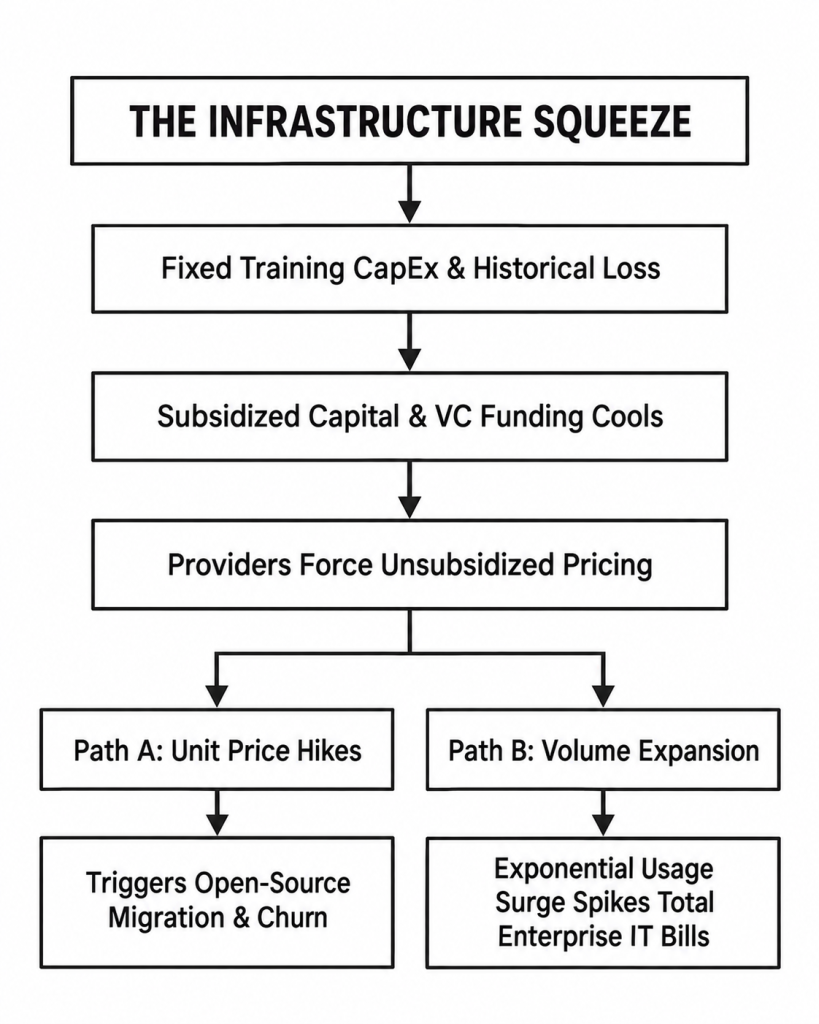 In software economics, attempting to close a corporate expense gap via a 1000% raw unit price hike triggers immediate market failure:
-
The Open-Source Ceiling: Open-source architectures (e.g., Meta’s Llama series, Qwen, DeepSeek) provide a natural price ceiling. If proprietary labs increase raw token fees by multiples, enterprise clients will migrate workloads to self-hosted or local cloud clusters.
-
The Real Expense Multiplier – Volume: The financial shock to enterprise clients will not stem from a 10x increase in the price per token, but from a 10x to 15x surge in cumulative compute consumption. As companies move from basic search prompts to autonomous, background-running “agentic workflows” –
where models loop continuously to execute multi-step logic – token consumption scales exponentially.
An enterprise spending $20,000/month on simple API calls today can easily see that bill expand to $250,000/month as autonomous agents deploy at scale.
Section 3: The Single-Supplier Lock-In Trap
Many enterprise executives treat LLM integration like a standard SaaS subscription, assuming they can switch providers if pricing or terms change. In practice, deep AI integration creates unprecedented operational lock-in:
-
Architectural Coupling: Prompts, system instructions, guardrails, context windows, and multi-agent routing logic are tuned specifically to individual model behaviors. Switching from one provider to another often breaks subtle reasoning chains, requiring months of re-engineering.
-
The Margin Squeeze: As subsidized VC capital cools and providers pass unsubsidized compute costs down to enterprise buyers, locked-in clients face a difficult choice: absorb higher operational costs, pass cost increases onto end customers (risking demand drop-off), or undertake costly model migrations.
When enterprise buyers realize that AI integration squeezes their own operating margins rather than expanding them, user adoption curves risk stalling.
Section 4: The Regulatory TAM Squeeze (EU AI Act & Geopolitical Risk)
The assumption that frontier labs will enjoy friction-free global TAM (Total Addressable Market) expansion is directly challenged by tightening regulation and geopolitical policy.
1. Regulatory Compliance as a Fixed Overhead
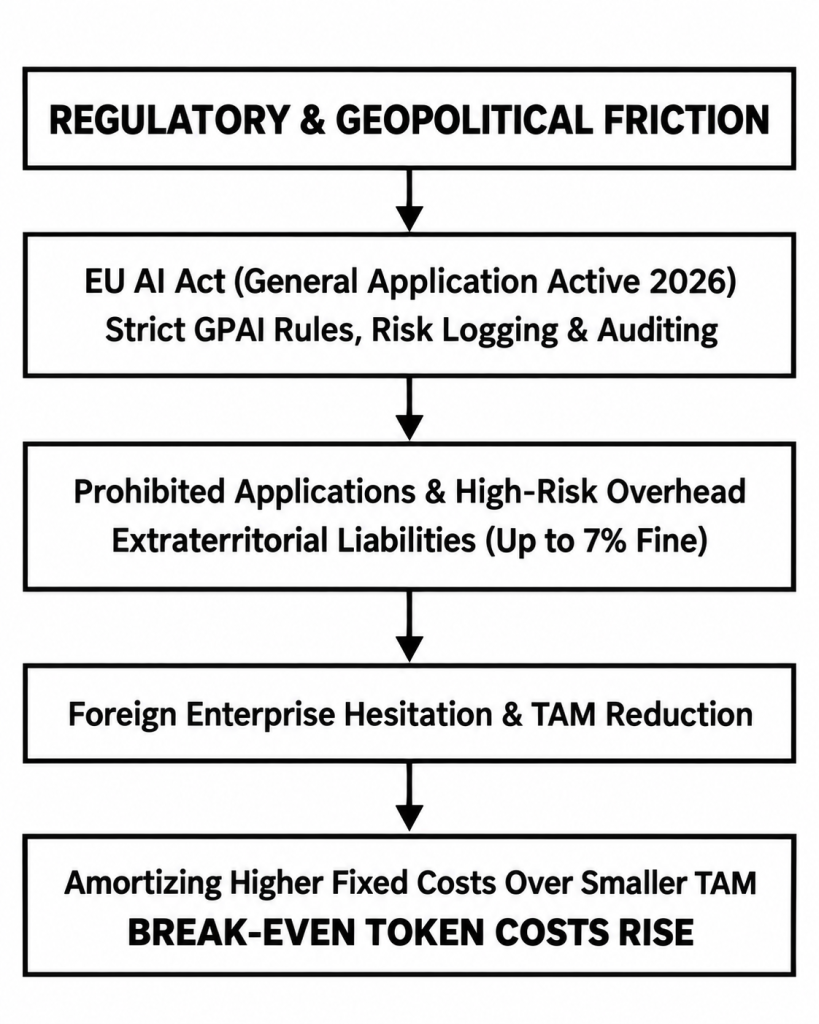
The full application of the EU AI Act enforces rigorous compliance mandates across Europe:
-
GPAI & Transparency Rules: Providers of General Purpose AI models face strict documentation, copyright compliance, and systemic risk management requirements.
-
High-Risk Liabilities: Deploying AI in high-risk categories (employment, credit scoring, critical infrastructure) requires extensive risk audits and logging. Downstream deployers who customize models risk inheriting full provider liability, carrying potential fines up to €35 million or 7% of global annual turnover.
2. Geopolitical Export Controls & Single-Vendor Risk
Enforcement actions – such as global model freezes or export control restrictions mandated by U.S. regulatory directives have highlighted single-vendor risk for international clients.
When global enterprise buyers realize access to proprietary models can be restricted or modified overnight due to foreign trade policy, reliance on single-country proprietary providers becomes a strategic liability.
3. The Mathematical Impact on Break-Even
Regulation creates a double-whammy: it increases compliance and legal overhead (expanding the numerator of required costs) while simultaneously restricting or delaying product categories and foreign enterprise adoption (shrinking the denominator of Total Addressable Market volume).
\text{Required Price per Token} = \frac{\text{Fixed Capital Costs} + \text{R\&D Losses} + \text{Regulatory Compliance Overhead}}{\text{Addressable Market Volume } (\text{Shrunk by Compliance Friction \& Geopolitical Risks})}
If the addressable market contracts due to compliance hurdles and single-vendor risk,
the unit cost required to recover capital investments increases.
Conclusion: The Strategic Correction Ahead
Is AI a bubble or a boom?
The underlying technology represents a transformative industrial shift,but the current financial model backing multi-trillion-dollar valuations faces a structural correction.
The market has priced in exponential growth without accounting for the realities of capital recovery, unsubsidized compute costs, deep enterprise lock-in, and global regulatory friction.
When private subsidies cool and enterprise buyers are forced to account for the true, unsubsidized cost of compute against their own operating margins, the market will shift away from speculative valuation toward fundamental economic discipline.
The companies that survive the coming correction will be those built on sustainable unit economics, architectural flexibility, and transparent ROI.