 A C-Level Leader’s Framework for Functional, Practical Hiring.
The prevailing narrative in technical recruitment presents founders and CTOs with an artificial choice: drown in hundreds of resumes, or hand the keys over to automated applicant tracking systems (ATS) and external recruiting agencies.
Proponents of total delegation argue that an executive’s time is too valuable to spend reviewing CVs.
They promise a frictionless world where algorithms screen the noise, external recruiters run the preliminary filters, and executive leadership simply shows up to interview the “top three finalists.“
The same exists in many HR settings – set up the ATS to filter on keywords, missing the NodeJs for the entered keyword Node.Js, even though the two are the same, and this is just one example of far too many.
In practice, this model breaks early-stage and scaling engineering teams.
When you outsource domain judgment to non-technical recruiters or blunt keyword scrapers, you reliably introduce two fatal failure modes:
-
Aggressive false negatives:
Battle-tested engineers who prioritize building production systems over keyword-stuffing their resumes are discarded before a technical human ever sees their name. -
Superficial false positives:
Candidates who have mastered interview-prep algorithms and corporate buzzwords glide through non-technical screening gates, landing directly on the executive calendar and burning expensive technical hours across everyone involved.
You do not outsource a building’s foundation inspection to an administrator who cannot read structural blueprints.
Setting the technical bar is not a clerical chore – it is an existential business responsibility, especially in startup settings, where hiring mistakes can have extremely high and costly consequences.
The solution to recruitment fatigue is neither micromanagement nor total abdication. It is The Domain-Led Funnel – an asymmetric, progressive screening architecture that preserves executive bandwidth, eliminates automated noise, and guarantees technical calibration from day zero (the writing of the non-unicorn job spec).
The Core Thesis: Asymmetric CV evaluation
The goal of resume evaluation is not to find a reason to hire someone from a piece of paper; it is to fail non-viable candidates early, cheaply, and deterministically, while preserving deep domain scrutiny for the small pool of viable talent.
By segmenting the evaluation pipeline into distinct, progressive tiers – separating administrative compliance, rapid sanity checks, and deep technical reads – an engineering leader can process an inbox of 100 applications in under two and a half hours.
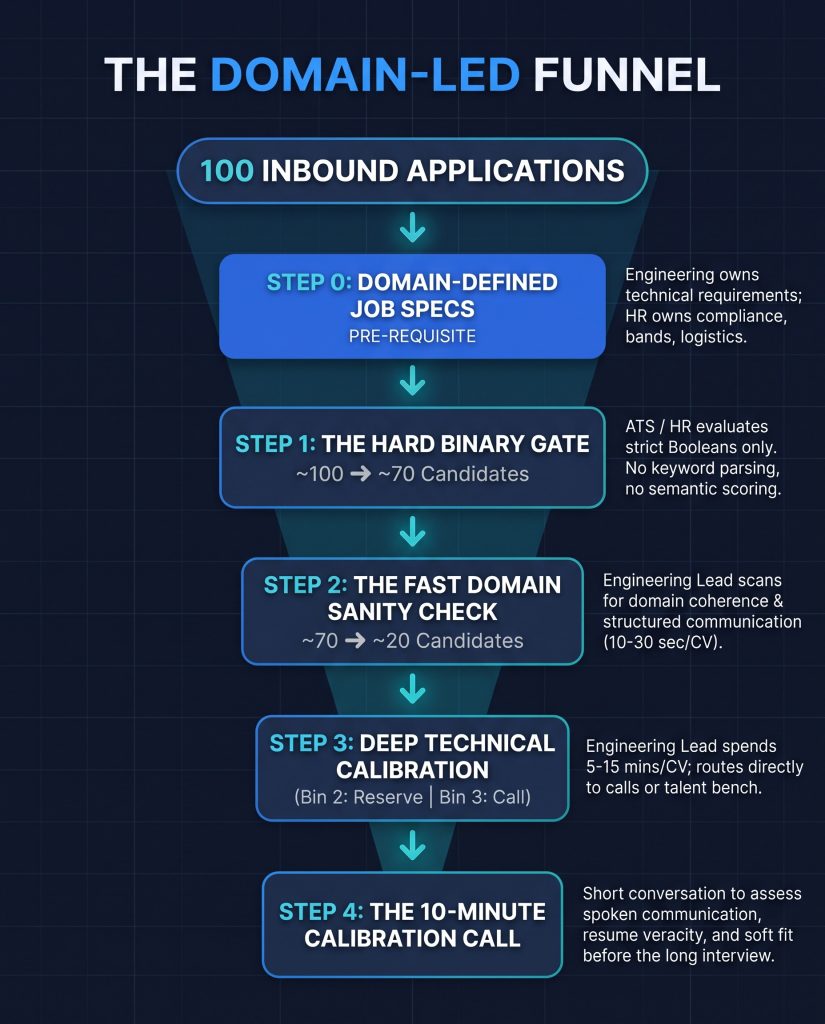
Step 0: Decoupling Specification from Administration
A broken hiring pipeline is usually the product of a broken job specification.
Most job descriptions devolve into disjointed “wish lists” because Human Resources and Engineering draft them in an unstructured vacuum, resulting in unicorn criteria that no real engineer meets (see Unicorn Jobspecs).
The Domain-Led Hiring begins with a strict division of drafting ownership:
-
The Functional Domain Owns the Core Bar:
The CTO or other functional Hiring Manager defines the exact non-negotiables, the required background, the nature of the trade-offs the hire will face, and the specific failure modes of the role.
HR is barred from unilaterally adding technical “nice-to-haves” or stacking disconnected framework requirements onto the spec. -
Human Resources Owns the Operational Guardrails:
HR establishes the compensation bands, regional employment compliance, visa viability, operational benefits, and overarching cultural and workplace standards.
When domain requirements are insulated from bureaucratic bloat, the resulting profile reflects a real human domain actor, rather than an impossible checklist, be that a technical, finance, ops or any other role.
Step 1: The Strict Binary Choice (Administrative Triage)
The primary reason ATS software has earned a toxic reputation is because organizations misuse it: they task a machine with evaluating subjective domain expertise via keyword matching or probabilistic AI parsers.
Algorithms cannot assess technical nuance, but they are exceptionally good at checking boolean parameters.
In Step 1, automated screening or entry-level HR review is strictly confined to binary business requirements:
-
Right to Work:
Does the candidate have legal authorization to work in the relevant jurisdiction, or do they require sponsorship that the company cannot support? -
Location & Timezone Constraints:
Can the candidate support the required core working hours, whether remote, hybrid, or on-site? -
Hard Compliance Baselines:
Does the role require an active security clearance, specific professional liability insurance, or localized / professional licenses?
Regulatory concerns?
Binary selections? You are generally in the clear, as these are commonly and explicitly explainable and legally/regulatory defensible.
What is Explicitly Prohibited at Step 1:
-
No Automated Keyword Matching:
The ATS must never score or filter candidates based on how many times “Kubernetes” or “Distributed Systems” appears in their text. -
No Semantic AI Resume Scoring:
Automated tools are barred from ranking candidate “fit.” -
No Rigid Experience-Year Traps:
Arbitrary filters (such as requiring exactly 5+ years of a specific framework) are stripped out. Hard cutoffs at this stage should only reflect legal, jurisdictional, or fundamental operational limits. - EU (and others) – No AI rejection decisions:
(See the EU AI Act article for specifics), as while not explicitly disallowed, it is highly regulated, and likely to cause issues where it concerns Hiring – “CV screening, hiring, promotion, termination recommendations”.
You MUST be able to explain the reason for the decision to reject. Can you explain the reason AND the process behind if an AI did it?
Every candidate who passes this stage meets the baseline business parameters.
The pile has shrunk without discarding a single qualified engineer over a formatting or keyword technicality.
Step 2: The Domain Sanity Check (10 to 30 Seconds per CV)
Once the applicant pool is legally and operationally viable, it is handed immediately to a technical domain lead – not an external recruiter, and not a junior HR generalist.
The idea that an engineering leader lacks the time to review these profiles is an operational myth.
At this stage, the lead is not reading every line of every resume; they are conducting an initial sanity pass, spending 10 to 30 seconds per document to sort profiles into two simple bins:
-
Bin 1 (Reject): Immediate mismatch or non-viable presentation.
-
Bin 2 (Proceed): Cleared for deep technical evaluation.
What the Domain Lead Evaluates in Seconds:
-
Domain Relevance: Does the candidate’s career progression have any reasonable connection to the open position?
(e.g., screening out a short-order cook applying for a Staff Infrastructure Architect role – something that can even be done at HR level without risk as a pre-screening on any obvious domain mismatches). -
Structural Communication and Signal-to-Noise Ratio: How does the candidate present complex information?
The Philosophy of “Format as Signal”
Some hiring philosophies argue that evaluating a resume’s structure or readability is superficial, suggesting that a brilliant systems engineer might simply be bad at writing resumes. In high-performance organizations, this assumption is an operational hazard.
A resume is an engineer’s self-directed engineering document. It is a system intended to communicate complex technical history, achievements, and responsibilities to a targeted reader under constrained real estate.
If a candidate delivers a resume that is chaotic, incoherent, riddled with formatting breakdowns, or incapable of presenting a cohesive message, they are demonstrating a failure of technical communication.
In an engineering organization – especially within startups and lean teams – an engineer who cannot serialize information clearly on a document will not serialize information clearly in production. They will write unreadable pull request descriptions, produce opaque architecture docs, fail to communicate trade-offs across cross-functional teams, and struggle during high-severity incident post-mortems.
Technical competence that cannot be communicated cleanly is an operational liability, not an asset.
If an applicant fails the fundamental test of structuring their own technical story, they are moved to Bin 1 immediately.
Step 3: Deeper Technical Check (The 3-Bin Engine)
The remaining pool – typically 15 to 25 percent of the initial volume – now represents candidates who are logistically viable, functionally experienced, and capable of coherent professional communication.
Now, and only now, does the domain lead invest serious analytical time (5 to 15 minutes per candidate).
During this stage, the evaluator analyzes the architectural fingerprints on the page:
-
Are the accomplishments framed in terms of business impact, scale, and technical trade-offs, or merely passive task lists?
-
Does their tenure at past companies reflect real domain ownership, or did they consistently hop teams before their design decisions had to be maintained and debugged in production?
-
Does the candidate demonstrate familiarity with the actual structural complexities of your operational scale?
The reviewer sorts this refined group into a definitive three-bin architecture:
| Bin | Classification | Action |
| Bin 1 | Unqualified / Poor Alignment | Immediate Rejection: Log reasons cleanly for record-keeping and send a prompt, respectful rejection notice. |
| Bin 2 | Viable Bench (Reserve) | Active Standby: Strong candidates who meet the domain baseline but rank slightly behind top contenders on immediate domain overlap. |
| Bin 3 | High-Fit Primary Choice | Schedule Technical Interview: The primary choice (typically 3 to 5 candidates) routed directly into formal interviews. |
The Power of the “Reserve” Bin (Bin 2)
Most recruitment pipelines suffer from an “all-or-nothing” approach: companies pick two favorites, reject everyone else, and find themselves back at square one when their top picks decline an offer or fail a live systems-design interview weeks later.
The Reserve Bin (Bin 2) prevents this pipeline bankruptcy. If the primary candidates in Bin 3 do not pan out, you do not restart the search, re-engage agencies, or lower your standards. You immediately reach into Bin 2 and pull the next pre-checked candidate forward for an interview.
The pipeline stays warm, deterministic, and resilient.
Batch Processing vs. Continuous Flow
The Domain-Led Hiring operates seamlessly across two different operational cadences:
1. Batch Mode (Recommended for Dedicated Hiring Sprints)
When launching a new role, collect applications over a set window (e.g., 5 to 7 days).
Review them in discrete, time-boxed blocks:
-
The Initial Triage (Steps 1 & 2): Process 100 applications down to 20 viable candidates in roughly 30 to 45 minutes of total review time.
-
The Calibration Pass (Step 3): Take a dedicated 90-minute block to read the final 20 profiles, sorting them definitively into Bins 1, 2, and 3.
-
Total Time Invested: Under 2.5 hours of executive time to produce an interview-ready slate.
2. Continuous Flow / Individual Rolling Mode (For Always-On Roles or late arrivals)
When hiring continuously, or screening late applicants, you do not need to wait for the full 100-resume batch.
Compress the exact same decision tree into a single-pass hierarchical gate per applicant:
-
Gate 1 (Logistics): Does this profile violate hard location, visa, or compensation bounds?
If yes ⇒ Bin 1 (Reject). -
Gate 2 (Sanity & Clarity): Does a 10-second scan reveal unreadable formatting, incoherent communication, or total domain irrelevance?
If yes ⇒ Bin 1 (Reject). -
Gate 3 (Deep Read): If the candidate clears the first two gates, spend 5 to 10 minutes analyzing their technical depth, instantly routing them to Bin 1, Bin 2 (Reserve), or Bin 3 (Interview – you spend some more time to re-read to prepare).
The guiding operational principle remains intact regardless of cadence:
fail early, fail cheap, and ensure cognitive load is expended exclusively on vetted, high-potential profiles.
Step 4: The 10 min pre-interview call.
Before booking an intensive 60-minute technical interview or gathering an interview panel, run a preliminary 10-minute voice or video calibration call with each candidate in Bin 3.
This is not a deep architectural interrogation or a grilling session.
It is a low-friction, casual, initial and conversational sanity check designed to evaluate the critical operational soft skills that paper cannot reveal:
-
Spoken Communication & Articulation:
Can the candidate explain complex ideas clearly, concisely, and spontaneously without hiding behind prepared scripts? -
Linguistic & Professional Clarity:
Is there mutual ease of communication, or will language friction slow down critical syncs, code reviews, and incident handling? -
Resume Veracity:
When asked off-the-cuff to clarify a single project or choice listed on their CV, do they speak with natural familiarity, or does their narrative unravel? -
Basic Demeanor & Professional Presence:
Are they collaborative, self-aware, and aligned with the operational realities of the team?
The Two Outcomes:
-
The Clean Filter ⇒ Reject:
If the candidate lacks foundational communication skills, displays a combative attitude, or cannot speak convincingly to their background, the interaction ends cleanly. You save 50 minutes of valuable technical time, close the loop with a polite rejection, and protect your team’s calendar. -
The Escalation ⇒ Interview:
If the candidate proves articulate, grounded, and technically coherent, you book the comprehensive deep-dive interview with confidence, knowing the baseline operational fit is already proven.
By inserting a firm 10-minute conversational gate before dedicating hours of multi-person engineering time, you ensure deep technical interviews are reserved exclusively for candidates who can actually operate effectively within a human team, not wasting costly technical and executive time and effort, still probing the soft “culture” fit and skills, which is also necessary for a successful hire.
The interview:
Stop screening for the perfect match or your wish or past employee, and start looking for new influence, new ideas, the ability to adapt, learn, influence, solve problems, critical thinking.
Instead, look for the basic domain needs you have, not the perfect match, and start looking for things such as ability, adaptability, aptitude, problem solving, general intelligence, because these will let anyone with the right basics adapt.
Tech frameworks, models, ops insights, paradigms, …. come and go in cycles, and the one thing you do not want, is a Resume-Driven Development (RDD), where people focus on the latest and greatest to pad their CVs, making them forward hireable, often to the detriment of the employer, who often just wants – functional, reliable delivery.
Also, be aware that when you hire, you are hiring fresh ideas, not another voice in an echo-chamber.
You are hiring to extend your team, not to cement an echo-chamber or to entrench current habits, even while there has to be compatible team similarities.
Instead, ask the simple questions – can they do it, how fast, and how well?
After all, you do not want to list the role as unfilled 6 months down the line, having the applicant ask – why has it not been filled before?
.. It’s a completely valid hard red flag to any applicant.
The flow
Keep the pipeline clearly communicated from the day you advertise – leaving the people applying knowing what to expect, roughly when, along a timeline.
If you say you will call back, let people know, and.. do it.
Do NOT ghost your applicants – it will only place you unfavourably in the public view.
Again, If you say you will do something, do it!
… and when in the interview stage, keep it short.
If you can’t make up your mind in 2 weeks, do you actually know what you are hiring, and what you are really looking for?
Do you really need 4, 5 or even more interviews?
Be serious about your hiring – it is a serious investment for both parties!
The Strategic Return on Investment
Treating technical recruitment as an administrative burden to be completely automated or outsourced is an expensive operational shortcut.
The downstream cost of a bad hire – wasted payroll, degraded team morale, domain debt, and another recruitment cycle three months later – vastly outweighs the couple of hours required to screen incoming profiles correctly.
By enforcing strict binary boundaries for non-technical screening, insisting on written clarity as a proxy for operational execution, and keeping domain experts in control of technical evaluation, the Domain-Led Funnel protects your calendar without sacrificing your hiring standards.
You protect your domain culture not by distancing yourself from the hiring process, but by engineering the funnel so that only the viable signal makes it to your desk.
Don’t miss the viable candidates to an automated ATS – It may cost you dearly…